Prism Sights/Scopes
Updated 2017-10-30
Updated 2018-12-18 Added Primary Arms 1x
Cyclops
Updated 2020-12-14 Added Bushnell Lil P, Removed higher magnification entries as these are better
served by variable power scopes.
Why Prism Based Optics?
For the most part I
purchase Prism Scopes as they fill a niche that I'm particularly interested in.
They work perfectly
for people who have astigmatism.
They also have
diopters, so they can correct for most people with poor vision.
I do have astigmatism
and poor vision so Prism Scopes are excellent tools for improving my accuracy.
Prism based scopes
work for people who cannot use Red-dots or Holographich
sights.
Although Prism Scopes
all use batteries to illuminate their reticles they can function without
batteries.
The reticle is
actually etched in the prism and will appear black when the scope is turned off
or the battery dies.
Typical users do not
need backup iron sights.
Note, as Prism scopes
do have a diopter in them and most also offer magnification, a co-witness setup
will not work well.
Depending on the
amount of correction used from the diopter, this could still be an issue for a
1x-magnification optic.
If backup iron sights
are a must have for you, I suggest finding a quick detach option if possible for your optic.
Another option, if
the firearm has the rail space would be to purchase canted iron sights, such Magpul's MBUS Pro Offset Sights.
Prism Scopes can have
simple circle-dot reticles or the reticle can be fully designed to account for
BDC over distance (Bullet Drop Compensation)
Prism Based Optics' Drawbacks
1st is
that they are optical scopes, so Eye Relief affects where the device can be
setup on your firearm.
FYI: The eye relief of an optical instrument (such as a telescope)
is the distance from the eyepiece within which the user's eye can obtain
the full viewing angle.
If a viewer's eye is outside this distance, a reduced field of
view will be obtained.
i.e. if your eye is not the right
distance from the sight you will notice vignetting.
Typically for prism
scopes this distance is 3" to 4"
2nd is that they are heavier then Red Dots Sights.
3rd when competing against telescopic scopes prism scopes
have fixed magnification, where most telescopic scopes have some form of
magnification adjustment like a zoom camera lens.
AVAILABLE OPTIONS
The Prism Sight/Scope
Market is not as large as the Red Dot market with
considerably less options.
While on my Red Dot
/Holographic sight page I only gave a few examples,
here I will cover
most of what is commonly available in the midrange in Canada.
The manufacturers in
this field are: Burris, Primary Arms and Vortex.
Note: Burris and Vortex both offer: no questions
asked, life time warranties.
I have used the
warranty for an old Vortex Spitfire and they replaced it with the newer AR
version mentioned below.
I am impressed with
Vortex's service in this regard.
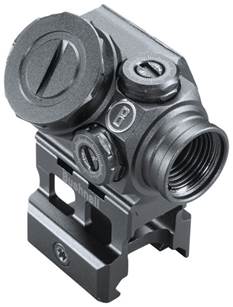
Sights are listed
alphabetically.
$395
While optically not as
good as its immediate competitors' this is still a good sight that is by far
the smallest and the lightest of the bunch.
It comes with both a
1/3 co-witness mount and a low mount and is thus easily usable in a wide
variety of situations.
It is the only option
here that physically is similar in size to a typical Red-Dot
It weighs in at 5oz
when using the high mount.
Eye Relief is nearly
3.5".
It uses CR2032
batteries and they claim 50,000 hours of use.
Note, this optic is
not parallax free like the other models listed here.
Parallax is set at 50
yards which is OK for this type of optic.
With an 11mm
objective lens it definitely has a narrow field of view.
In short: it is
small, light and versatile which for some will make up for its narrow
field of view and not being parallax free.
Of the 3 optics listed on this page this one is a very close 2nd place for me.

Primary
Arms 1X Compact Prism Scope - Illuminated ACSS Cyclops Reticle
$370
For fast target
acquisition this may be the best prism-based optic around.
The horseshoe in the
optic is quick to pick up visually and get on target.
The 'chevron in the
horseshoe', in my experience, is a little harder to be precise
and because the reticle is visaully smaller than the competition's it can take longer to acquire it when aiming
than the 'dot within
the circle' that the Vortex listed below uses.
When illuminated
there are 12 brightness levels but only in Red.
The control is a
rotary dial which is nice and tactile.
It weighs 10oz.
It comes with
absolute co-witness height mount.
It is compatible with
Aimpoint T1 mounts, but if you use an Aimpoint T1 absolute co-witness mount you
will end up with the optic being slightly higher than 1/3 co-witness.
So, do not expect to get
standard heights from standard mounts.
Eye Relief is nearly
4".
It uses CR2032
batteries and I am guessing it will last 1,500 to 2,000 hours of use.
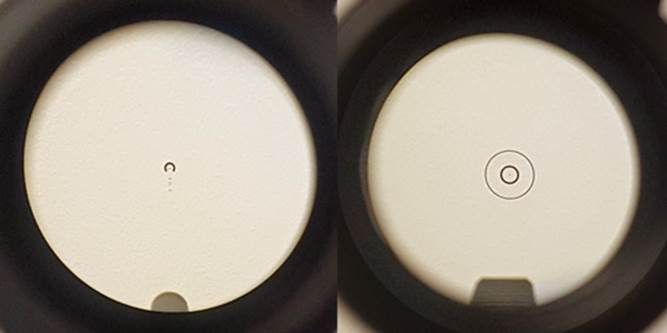
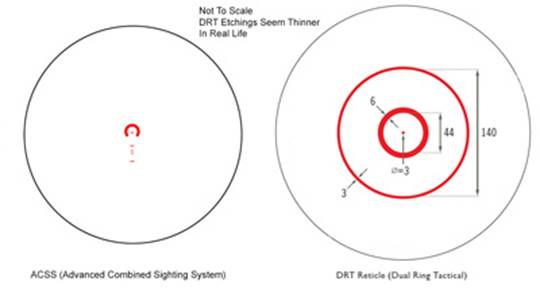
On the left is the
Primary Arms Cyclops reticle, on the right is the Vortex Spitfire reticle.
(Sorry, I could not
get them sharper.)

$400
The reticle is a dual
ring with a 1MOA dot.
When illuminated
there are 5 brightness levels in both Red and Green.
I am not thrilled
with the illumination control buttons but they manageable.
It weighs 11oz.
It is AR style 1/3
co-witness height which cannot be adjusted.
Since there are no
low mount options for this optic, is not a good option for non-AR style
firearms.
Eye Relief is
3.7", which is pretty forgiving.
It uses a AAA battery
that will typically get 1,500 to 2,000 hours of use
FYI: I own one of
these and a couple of the older now discontinued Spitfire 1x models, which has
similar specifications.
I have used them on a
number of different firearms. (Thureon Defense, Norinco Type97 and a Freedom Ordnance FX-9.
I think it is a good
optic.
It is a good precise
Red-Dot like option for people with astigmatism and poor vision (like myself).
As long as your firearm can use an AR height optic this would be my first choice.
The versatility and size of the Bushnell Lil P makes it a very close 2nd choice.
Availability:
CTC Supplies seems to be the exclusive
distributor for Primary Arms in Canada.
I says seems, as I do not know this for fact but I
have only seen them on sale on their web site.
Vortex and Bushnell are commonly available at many Canadian retailers.